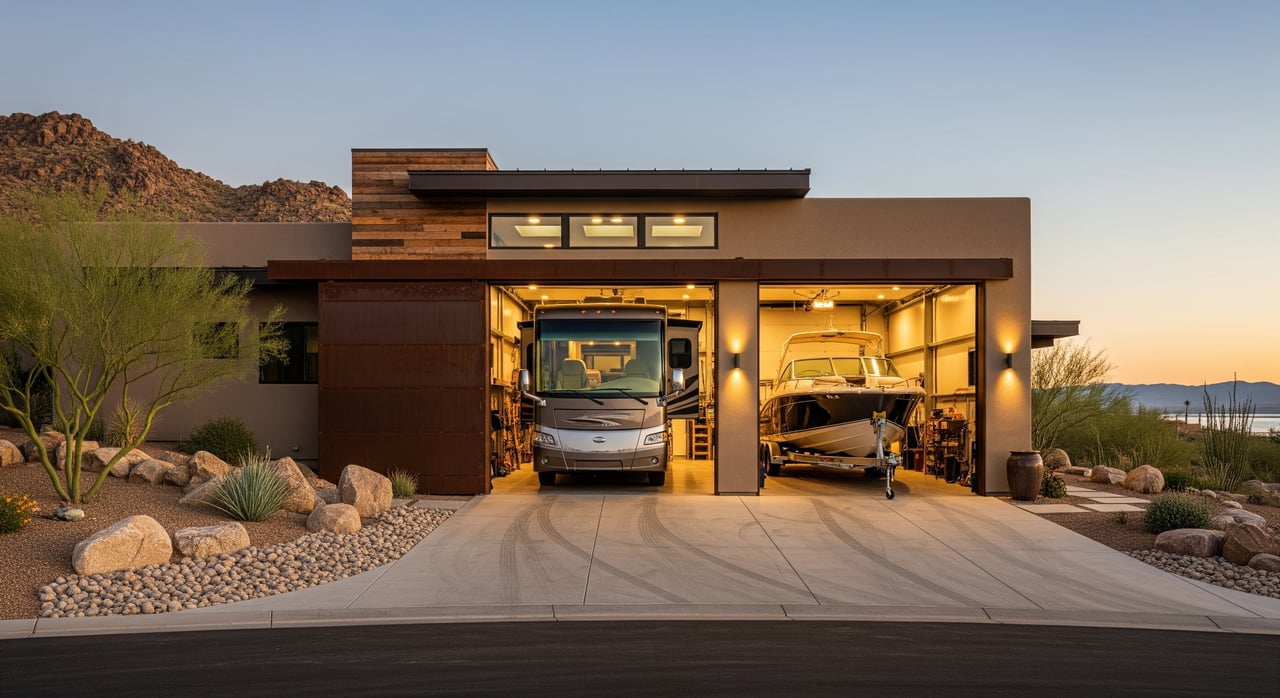
Dreaming of rolling into your Lake Havasu home, parking the rig inside, and heading straight to the lake? In The Foothills, the right RV garage or boat bay can make that a reality. You face unique terrain, narrow streets, and serious summer heat, so details like door height, bay depth, pull-through access, hookups, and cooling all matter. In this guide, you’ll learn what works in The Foothills, how to plan smart upgrades, and which features help resale. Let’s dive in.
Why Foothills lots change the plan
The Foothills sit on sloped, rolling terrain above the lakeshore. That slope, along with lot shape, often limits footprint and bay orientation. It also influences driveway slope and curb cuts, which affect how you enter with a long trailer.
Streets in the area can be narrower or curved with grades that make turning and backing tougher for longer rigs. If you plan to store a tall motorhome or a wide boat on a trailer, driveway length and turning radius should be on your short list.
Heat is the other major factor. Lake Havasu City’s hot desert climate brings intense sun and high summer temperatures. UV exposure can wear on seals and finishes, and heat load drives your choices for insulation, cooling, and ventilation.
Before any work begins, confirm rules and approvals. Check with Lake Havasu City Planning and Building for permits and driveway changes. If the property falls outside city limits, contact Mohave County. Review HOA design guidelines in your subdivision, confirm utility service capacity and meter locations, and verify drainage and flood maps if relevant.
Door heights and widths that actually fit
Getting through the door is non-negotiable. Match the opening to your specific rig, including antennas, AC units, towers, racks, and mirrors.
- Small boats, ATVs, utility trailers: 8–9 ft doors often work.
- Travel trailers and mid-size motorhomes: 10–12 ft doors are common.
- Class A motorhomes or tall coaches: 12–14+ ft is recommended.
- Boats on trailers: many fit under 9–12 ft, but boats with towers or cabins may need more.
For width, a single vehicle door usually runs 9–10 ft. For an RV or boat bay, 12–14 ft gives more comfort. Wider openings, 16–20 ft, help with mirror clearance and reduce stress in tight spots. For multiple bays, plan 24–40 ft of total width or use separate doors based on your layout.
Depth and vertical clearance inside
Depth determines whether you can close the door with room to walk around, plug in, and store gear.
- Car plus small trailer: 20–30 ft depth.
- Travel trailer, 20–35 ft long: 30–45 ft depth is a good target.
- Large motorhome, 35–45+ ft: 45–70+ ft depth for full indoor parking.
Allow 2–6 ft of extra clearance beyond vehicle length for bumpers, hookups, and circulation. Inside height matters too. Account for air conditioners, satellite domes, roof racks, and any boat towers. Structural beams, openers, and lighting must sit above the tallest point of your rig.
Pull-through vs back-in: what works here
Pull-through bays let you drive straight in and out the other side. They are ideal for long motorhomes and boats, especially with the slopes and narrow streets you see in The Foothills. They also avoid complex turning and can be a strong resale feature for RV owners.
The tradeoff is space. Pull-throughs require enough lot depth and the right access configuration, which can be tough on smaller or steeper lots. They also cost more because of the larger footprint and driveway work.
Back-in bays are more common and fit more lots. They cost less space but can be tricky with long rigs and tight street geometry. You may need a reinforced driveway and a wider curb cut.
Structure and floors built for heavy loads
RVs and large boats put concentrated weight on the slab. A thicker slab with proper reinforcement is often needed. Work with a contractor or engineer to match your loads and comply with local codes.
Plan for drainage. A slight slope to the exterior or into a trench drain helps keep water out of living areas. Some interior floor drains require specific plumbing approvals, so confirm before you pour.
Consider a durable coating. Epoxy, polyaspartic, or polyurea coatings protect from hot tires, UV exposure, and spills. They also make cleanup faster after a day at the lake.
Hookups and systems that make life easy
Practical utilities can turn a big bay into a high-functioning home base. Installations should be permitted and completed by licensed trades.
Electrical
- Smaller RVs often use 30 amp/120V (NEMA TT-30).
- Larger coaches typically need 50 amp/240V (NEMA 14-50 or similar) on a dedicated breaker with correctly sized conductors.
- EV charging is separate from RV shore power and needs its own dedicated 240V circuit.
- Confirm your main service capacity. A 200A+ service may be necessary if you add 50A shore power and other loads.
- A dedicated subpanel near the bay simplifies outlets, lighting, chargers, and future circuits.
Buyers also appreciate touches like a mounted power pedestal, an easy-to-read subpanel, and conduit for future additions.
Plumbing and sewer
- Freshwater: a hose bib and a dedicated RV fill are common. Consider a pressurized fill with backflow prevention.
- Waste: options include a direct RV sewer hookup to municipal sewer or septic, a pump-out station, or portable waste handling.
- Direct connections must meet plumbing codes, with proper traps, vents, and permits. On septic, many areas limit direct RV dump connections or require engineered solutions. Always verify with the local authority.
Air and fuel
- Compressed air lines for tires and tools add convenience. Install safely and label clearly.
- Fuel storage and indoor fueling are heavily regulated and often discouraged. Keep fueling external and follow code requirements.
Solar and battery infrastructure
- Solar-ready conduit and space for inverters or battery systems appeal to owners who boondock or rely on DC power.
- Battery banks and inverter chargers need proper ventilation and fire separation according to electrical code.
Cooling and ventilation for Lake Havasu heat
In a hot, sunny climate, cooling and radiant control make the bay usable year-round and protect your equipment.
AC strategies
- Ductless mini-splits, even one per bay, offer efficient cooling and some dehumidification. They retrofit easily.
- Packaged rooftop or through-wall AC units help when ducting is difficult in larger bays.
- Extending the home’s HVAC can work if capacity allows. This requires insulation, air sealing, and careful load calculation.
- Evaporative coolers can help in very dry conditions but are less effective in extreme heat and add moisture. Use them thoughtfully.
Insulation and radiant control
- Use radiant barriers or reflective insulation under the roof, high-R wall insulation, and insulated garage doors to cut heat gain.
- Seal gaps and add weather-stripping to reduce hot air infiltration.
Ventilation and air movement
- Intake and exhaust fans or ridge vents help purge hot air when AC is off.
- Ceiling or wall fans improve circulation and comfort.
- Consider light ventilation or dehumidification to protect fabrics and electronics even in a dry climate.
Materials that last
- Choose UV-stable exterior finishes and UV-resistant door seals and hardware.
- Select floor coatings designed for heat and chemical exposure.
- Use corrosion-resistant metals where exposure to lake moisture is possible.
What buyers value and how it affects resale
Features that make daily use easier tend to have the most impact. The right door height, adequate depth, and a smooth access plan can turn a garage from frustrating to functional.
Convenience upgrades like 50A shore power, a dedicated water fill, a legal sewer hookup, bright lighting, and organized storage all add appeal. If you service your own gear, a workbench and well-lit surfaces are a plus.
For resale, permitted and professionally built bays attract RV and boat owners in the Lake Havasu market. Pull-through bays and direct hookups often stand out on listings. Documented permits and contractor receipts boost buyer confidence.
Be mindful of over-specialization. An extremely large or visually dominant bay can narrow your buyer pool. Unpermitted work can delay closings and raise repair demands. Always check HOA rules for visible storage and exterior changes.
Quick buyer checklist for The Foothills
Use this list when you tour a property or plan an upgrade.
- Measure your rig’s length, height, and width, including mirrors, antennas, towers, and AC units. Compare to the bay’s door height, interior clearance, and depth.
- Check driveway length, slope, and curb cut. If possible, practice the turn from the street with a spotter.
- Ask for permits and documentation for electrical, plumbing, and structural work.
- Confirm availability of 50A shore power, subpanel capacity, and meter location.
- Verify if the property is on city sewer or septic. If septic, ask about RV dump options.
- Evaluate cooling, insulation, and ventilation, including door insulation and any mini-split units.
- Review HOA rules about visible storage and accessory structures.
- Note proximity to ramps and backup storage options if the bay is ever full.
Seller prep checklist before listing
Set your property up to show well and pass inspection smoothly.
- Organize permits, receipts, and warranties for bay construction and utilities.
- If adding upgrades, prioritize safety and permitting. Have licensed electricians install shore power and licensed plumbers handle sewer connections.
- Make modest improvements with broad appeal: insulated doors, better lighting, floor coatings, and clean, organized storage.
- If something is unpermitted, consult the building department about retroactive permits or remedies, then disclose appropriately.
- Stage and photograph the bay with clear floor space and labeled hookups.
Is a pull-through feasible on your lot?
Ask yourself a few questions before committing.
- Do you have enough lot depth for a second exit or a long driveway loop? Many Foothills lots do not.
- Will a pull-through conflict with setbacks, slopes, or retaining walls?
- Can your street and curb cut handle the turning radius without major rework?
- Does your HOA allow a second curb cut or visible changes to the facade?
- Would a well-designed back-in bay with a wider door solve the same problem at a lower cost?
When to coordinate with local authorities
Plan early to avoid surprises. Contact the city or county for building, electrical, and plumbing permits. Ask utilities about service upgrades and meter placement. Review HOA design guidelines before finalizing exterior changes. If drainage is complex or a flood map applies to your lot, factor that into grading and slab design. A local contractor or architect with Foothills experience can help you assess feasibility and costs.
Ready to match your garage or boat bay to your Lake Havasu lifestyle? For expert guidance tailored to The Foothills, connect with Michelle Morgan. You will get local insight, trusted vendor referrals, and a clear plan to enhance usability and resale.
FAQs
What door height works for a Class A motorhome in The Foothills?
- Most Class A coaches need a 12–14+ ft door, plus extra interior clearance for roof equipment.
How deep should an RV bay be for a 35-foot trailer?
- Aim for 30–45 ft minimum, with 2–6 ft of extra space for hookups and safe walking clearance.
Are pull-through garages worth it on a sloped Foothills lot?
- Yes if your lot allows it. Pull-throughs improve usability and resale, but they require more space and cost more than back-in bays.
Do I need 50A power for a larger motorhome?
- Most larger motorhomes benefit from a 50 amp/240V circuit on a dedicated breaker with properly sized conductors and permits.
Can I connect my RV’s black and gray tanks to the home’s sewer?
- Often yes with the right permits, traps, and venting. On septic, rules can be stricter and may require engineered solutions.
What cooling system works best for a large boat bay in Lake Havasu?
- A ductless mini-split or a dedicated through-wall or rooftop AC unit is common when the bay is insulated and sealed.